


The following is a story of two men living a continent apart who had the exact same observation at precisely the wrong time.
In 1843, Oliver Wendell Holmes Sr. read a paper before the Boston Society for Medical Improvement titled The Contagiousness of Puerperal Fever. He wasn’t even an obstetrician. He noticed a physician had died just one week after performing a postmortem exam on a woman who had died of puerperal fever and came to the conclusion that birth attendants were carrying the disease from patient to patient via their hands.
He ended his presentation with eight concrete steps to prevent puerperal fever:
1. A physician holding himself in readiness to attend cases of midwifery, should never take any active part in the post‐mortem examination of cases of puerperal fever.
2. If a physician is present at such autopsies, he should use thorough ablution, change every article of dress, and allow twenty‐four hours or more to elapse before attending to any case of midwifery. It may be well to extend the same caution to cases of simple peritonitis.
3. Similar precautions should be taken after the autopsy or surgical treatment of cases of erysipelas, if the physician is obliged to unite such offices with his obstetrical duties, which is in the highest degree inexpedient.
4. On the occurrence of a single case of puerperal fever in his practice, the physician is bound to consider the next female he attends in labor, unless some weeks, at least, have elapsed, as in danger of being infected by him, and it is his duty to take every precaution to diminish her risk of disease and death.
5. If within a short period two cases of puerperal fever happen close to each other, in the practice of the same physician, the disease not existing or prevailing in the neighborhood, he would do wisely to relinquish his obstetrical practice for at least one month, and endeavor to free himself by every available means from any noxious influence he may carry about with him.
6. The occurrence of three or more closely connected cases, in the practice of one individual, no others existing in the neighborhood, and no other sufficient cause being alleged for the coincidence, is prima facie evidence that he is the vehicle of contagion.
7. It is the duty of the physician to take every precaution that the disease shall not be introduced by nurses or other assistants, by making proper inquiries concerning them, and giving timely warning of every suspected source of danger.
8. Whatever indulgence may be granted to those who have heretofore been the ignorant causes of so much misery, the time has come when the existence of a private pestilence in the sphere of a single physician should be looked upon not as a misfortune but a crime; and in the knowledge of such occurrences, the duties of the practitioner to his profession, should give way to his paramount obligations to society.
Because Holmes’ paper was published in a journal with a very small circulation, it went largely unnoticed until it was republished in 1855 as a booklet entitled Puerperal Fever, as a Private Pestilence.
The medical establishment overwhelmingly rejected his claims.
Leading Philadelphia obstetrician Charles D. Meigs dismissed his arguments as the “jejeune and fizzenless dreamings” of a sophomoric writer. Textbooks towed the same line, urging doctors to rid themselves of any notion that they could ever become “the minister of evil” to their patients. When confronted with clusters of deaths in a single practice, Meigs wrote that he preferred to attribute them to “accident, or Providence” rather than to a contagion he could not conceptualize.
Holmes responded to all of this rhetoric with admirable restraint. Of his critics, he wrote: “I take no offence and attempt no retort. No man makes a quarrel with me over the counterpane that covers a mother, with her newborn infant at her breast.”
Four years later and an ocean away, Ignaz Philipp Semmelweis arrived at the same conclusion through his own observations.
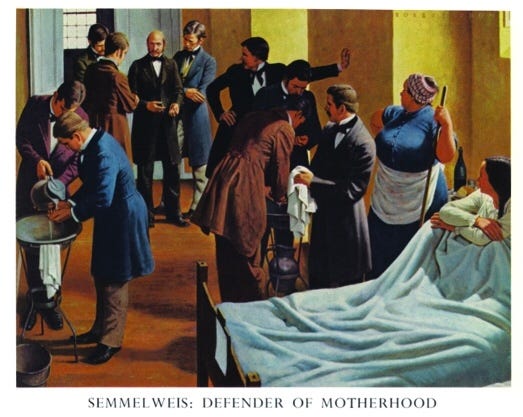
In 1846, Professor Johann Klein appointed Semmelweis as first assistant obstetrician at Vienna General Hospital. There were two divisions of the maternity clinic. In the first, medical students who also performed autopsies attended births. In the second, only midwives attended. The first clinic’s maternal mortality rate was three times higher than the second.
The breakthrough came when his friend Professor Jakob Kolletschka, a forensic pathologist, succumbed to a cut he sustained during an autopsy. Semmelweis examined Kolletschka’s autopsy findings and found them to be identical to those of mothers dying of childbed fever.
The conclusion was obvious: doctors were carrying “cadaverous particles” from the dissection room to the delivery room on their hands.
Semmelweis instituted a policy of handwashing with chlorinated lime before delivering babies. Mortality in his ward dropped from ~18% to under 2%.
When he mandated washing medical instruments, it fell to just 1%.
He published. He presented. He wrote letters.
The medical establishment overwhelmingly rejected his claims.
Despite being one of the first to witness the reduction in maternal mortality, Professor Johann Klein was hesitant to endorse the theory and declined to renew Semmelweis’ contract.
Semmelweis returned to Hungary and took an unpaid position. When his assistant later tried to publish their results in the Vienna Medical Weekly, the editors dismissed it as misleading information.
The Book That Should’ve Changed Everything
In 1861, Semmelweis published his major work, The Etiology, Concept, and Prophylaxis of Childbed Fever, a full-length account of everything he had observed and argued for over 14 years.
The work was not well received.
When inevitably faced with strong opposition, Semmelweis personally responded to each criticism by sending abusive letters to those who disagreed with his views, denouncing them as mother murderers and alienating himself further from his peers.
His book should have been his vindication. Instead it accelerated his unraveling.

The bitter relationship with his medical peers had a devastating impact on his mental health, leading to amnesia, anxiety, and severe depression. He was admitted to an Austrian asylum, where he was confined and beaten. Semmelweis succumbed to septicemia within 14 days of admission due to a wound infection from the beatings.
The man who discovered that dirty hands kill mothers died of a dirty wound in a psychiatric institution.
Semmelweis paved the way for the germ theory of disease, a concept later advanced by Louis Pasteur, Joseph Lister, and Robert Koch. Today he is called the savior of mothers.
Holmes, the more composed of the two, survived to see partial vindication, though it was not until the subsequent publications of Semmelweis, Lister, and Pasteur that the battle was finally won.
His reputation was eclipsed not by defeat but by his own brilliance in another domain, as he became one of America’s most beloved poets. Even his own profession came to value him more as a wordsmith than as a fearless defender of mothers.
Two men who had the same insight faced the same resistance to an uncomfortable truth. Neither lived to see their ideas fully embraced.
The Pain of Being Ahead of Your Time
The story gave medicine a name for a specific kind of institutional failure.
The Semmelweis reflex describes the tendency to reject new evidence because it contradicts established norms, beliefs, or paradigms.
The leading obstetrician Meigs was firmly against Semmelweis’s doctrine because “doctors are gentlemen, and gentlemen’s hands are clean.” That sort of statement is not a scientific claim but an identity-based one. And identity is much harder to revise than hypothesis.
The core driver is the threat to professional self-image. Accepting handwashing meant accepting that doctors had been unwittingly killing the very patients they were sworn to protect. The resistance was psychologically self-protective, which is exactly what makes it so dangerous. The cost of being wrong was unbearable, so the new evidence was rejected instead.
In the preface to his book The Myth of Mental Illness, Psychiatrist Thomas Szasz said Semmelweis’ story instilled in him “a deep sense of the invincible social power of false truths.”
The Semmelweis Reflex is Alive & Well
The Semmelweis reflex is not a relic and modern-day examples contain the same basic elements: evidence arrives, identity resists, patients suffer.
FMT for C. difficile
When researchers first proposed that fecal microbiota transplantation (FMT) could treat recurrent C. diff, the response from mainstream medicine ranged from skepticism to open mockery. When FMT showed 80-98% efficacy for C. diff after antibiotics repeatedly failed, the FDA initially classified it as an Investigational New Drug, requiring a formal IND just to administer it in life-threatening cases. The mechanism was and still is incompletely understood, as non-viable donor material paradoxically often helps.
Semmelweis didn’t know what “cadaverous particles” were either. He just knew that removing them from the clinical encounter saved lives. The data always precedes the mechanism. The reflex is most active when outcomes outpace mechanisms.
Low-dose ketamine for treatment-resistant depression
Ketamine was FDA-approved as an anesthetic in 1970. Its antidepressant properties were first published in peer-reviewed literature in 2000. It took twenty years and a rebranded, patent-protected intranasal formulation before mainstream psychiatry meaningfully engaged with it.
The delay wasn’t primarily about the data, which was compelling, with some studies showing response rates upward of 70% in patients who had failed multiple prior treatments. It was about the molecule’s cultural identity as a club drug, which made clinical legitimacy feel contaminating. The drug’s reputation preceded its evidence. Patients with treatment-resistant depression waited two decades while that reputation was renegotiated.
COVID-19 airborne transmission
By spring 2020, independent aerosol scientists were raising urgent alarms that superspreader events accumulating in choirs, restaurants, and poorly ventilated indoor spaces couldn’t be explained by large-droplet contact alone. The evidence clearly pointed to airborne transmission. The WHO and CDC clung to the droplet model anyway for the better part of a year.
Scientists pushing for the airborne framework described the experience in terms Semmelweis would have recognized: ignored, dismissed, told to stick to their lane. The WHO did not formally acknowledge aerosol transmission as the dominant route until 2021.
How We Should Proceed
There’s a note of caution worth including here. The Semmelweis reflex can also be invoked inappropriately, used as a rhetorical shield by people whose ideas genuinely don’t hold water. Not every rejected idea is ahead of its time. Some are simply wrong, and legitimate skepticism is not the same as reflexive dismissal. The history of medicine is full of ideas that were rightfully rejected.
But the pattern is distinguishable. Semmelweis and Holmes had data. They were not asking anyone to believe them on blind faith; they were asking people to look at the numbers. The resistance came not from the absence of evidence but from the psychological cost of accepting what the evidence implied: that the physicians themselves were the vector. That the institution was the problem.
The Semmelweis reflex recognizes cost to professional identity, institutional pride, and established paradigm as drivers of resistance to change.
The gap between evidence and acceptance is often vast and represents just how vigorously institutions respond to threat.
In his final days, Semmelweis wrote:
“When I look back upon the past, I can only dispel the sadness which falls upon me by gazing into that happy future when the infection will be banished, the destroyer of life annihilated, the weeping mothers will no longer be found, and the number of human beings who die from infection will no longer be counted. The conviction that such a time must inevitably sooner or later arrive will cheer my dying hour.”
He didn’t live to see it. But he was right.
Nita—Thank you for another wonderful essay. It will expand how I teach the story of childbed fever in my course. I only learned about Alexander Gordon during a 2023 study leave in the UK, and his account has stayed with me. In 1795—long before Semmelweis—Gordon described how puerperal fever was transmitted and wrote, “It is a disagreeable declaration that I was the means of carrying the disease to a great number of women.”
Wonderful article, thank you.
"The gap between evidence and acceptance is often vast and represents just how vigorously institutions respond to threat."
I see this very clearly in my specific field of study.