

We Contain Multitudes
Rethinking human identity through the hologenome

Have you ever grappled with the question of what makes us human? We think we exist as singular beings equipped with free will and autonomy. But what if our microscopic companions were the ones pulling the puppet strings?
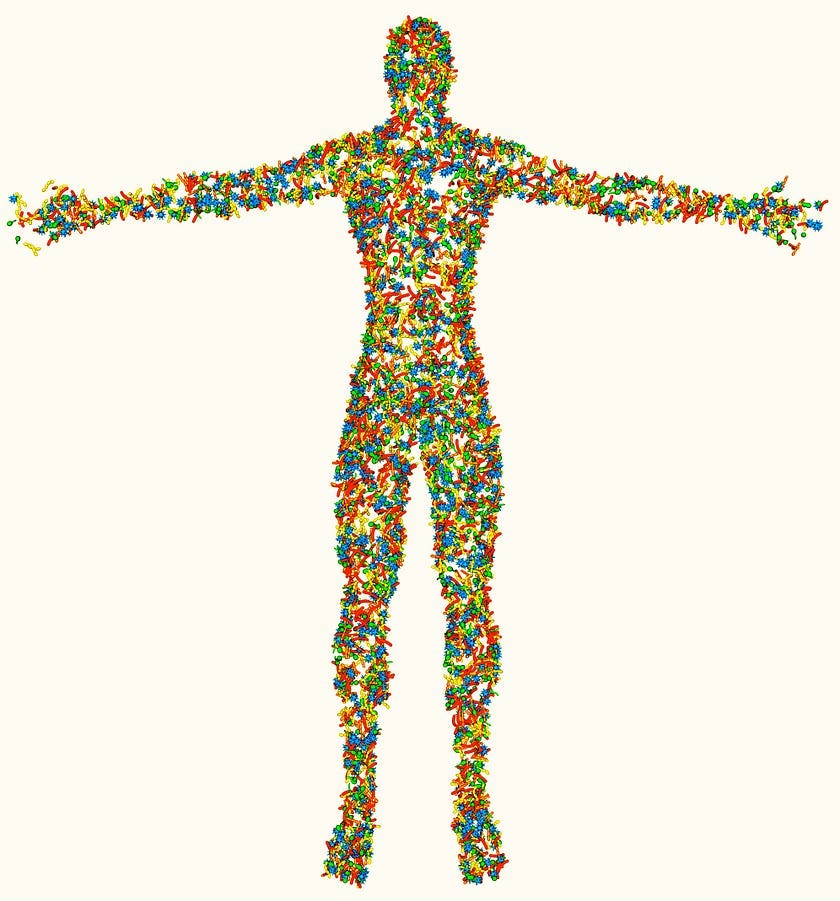
We are not individuals but walking, talking ecosystems that require feedback from our microbial symbionts and the outside world in order to regulate inflammation, train immune tolerance, maintain homeostasis. Forging ties with our microbial symbionts has allowed us to achieve what we never could in isolation.

Our human chromosomes provide an incomplete picture of the genetic information we carry and neglects the bacterial, archaeal, fungal, protistan, and viral genetic information that is equally integral to human identity if not more so.
Transposable elements or transposons, often referred to as “jumping genes,” are remnants of ancestral viral and parasitic infections that subsequently became integrated into the human genome in a manner similar to the CRISPR defense system in bacteria. More than 45 percent of the human genome is derived from transposons, whereas coding regions called exons comprise less than two percent.
The Missing Link in the Evolutionary Record
Evolution has occurred at a pace much too quick to be explained by random mutation alone. To compensate, biologists have also introduced additional mechanisms such as genetic drift, gene migration, gene flow, and epistasis. However, even these mechanisms cannot sufficiently explain the quantum leaps by which evolution has taken place.
To isolate the genes of an individual as the sole drivers of evolution is to ignore the contributions of billions of years of symbiotic coexistence, at a dangerous cost. We must unite Neo-Darwinist and Lamarckian views of evolution, akin to the attempt to unite gravity and quantum mechanics in physics. To understand evolution at the macroscopic scale, we need to examine evolution at the microscopic scale as well. Enter the hologenome.
“[The hologenome concept] embraces a vibrant and more satisfying view of the nature of biology, namely that the microbiome is as essential as the genome in defining what an animal or plant is and is not.”
— Neuroscientist Roman M. Stilling
The hologenome accounts for the genetic material of a host, or holobiont, plus all its symbiont microbiota. Many bacteria that live in and on our bodies multiply rapidly enough to go through several generations of offspring within the span of 24 hours, accounting for why antibiotic resistance evolves so rapidly.
Bacteria reproduce, mutate, and therefore evolve very quickly. In this manner, the hologenome can evolve at a much more rapid pace than the human genome. As science writer Ed Yong expounds in I Contain Multitudes,
“By partnering with microbes, we can quicken the slow, deliberate adagio of our evolutionary music to the brisk, lively allegro of theirs.”
The human body has 10 times as many microbial cells as DNA-bearing human cells. A 2016 study challenged the commonly quoted 10:1 ratio of microbial cells to human cells and estimated that a human body contains ~30 trillion human cells and ~40 trillion microbes, proposing a microbe to human cell ratio of about 1.3.
However, if we are solely interested in cells bearing genetic contents and therefore ignore the non-nucleated red blood cells and platelets, we again obtain a microbial/human result of about 10:1.

Keep in mind that this ratio does not account for mitochondrial DNA, which is also hypothesized to be microbial in origin. Mitochondria are organelles responsible for cellular energy production in animals, and chloroplasts are responsible for photosynthesis in plants. Microbiologist Eugene Rosenberg, who first posited the concept of the hologenome, explains,
“Mitochondria and chloroplasts can be considered ‘extreme symbionts’ because they were derived from alphaproteobacteria and cyanobacteria, respectively.”
The human microbiome consists of 3.3 million unique genes, a set 150 times larger than our own genome. However, examining the microbiome from a purely quantitative standpoint belies the real-world utility of microbial genetic diversity.
Generally, reduction in gut microbiota diversity, such as that induced by antibiotics, leaves the host vulnerable to infection, C. difficile infection being the most well-characterized example of this phenomenon.

Loss of microbial gene diversity is observed in many diseases, and fecal microbiota transplantation, a procedure designed to restore gut microbial diversity, has been shown to be beneficial for not only gastrointestinal conditions such as C. difficile infection, inflammatory bowel disease, and irritable bowel syndrome but also autism, allergies, autoimmunity, skin conditions, chronic fatigue syndrome, depression, diabetes, obesity, and neurological disorders.
The Microbiome Compensates for Host Defects
The predictive power of the microbiome may exceed that of genome-wide association studies when it comes to understanding complex human diseases. Microbial genes provides the crucial complement to features missing in the host’s core genome.
